
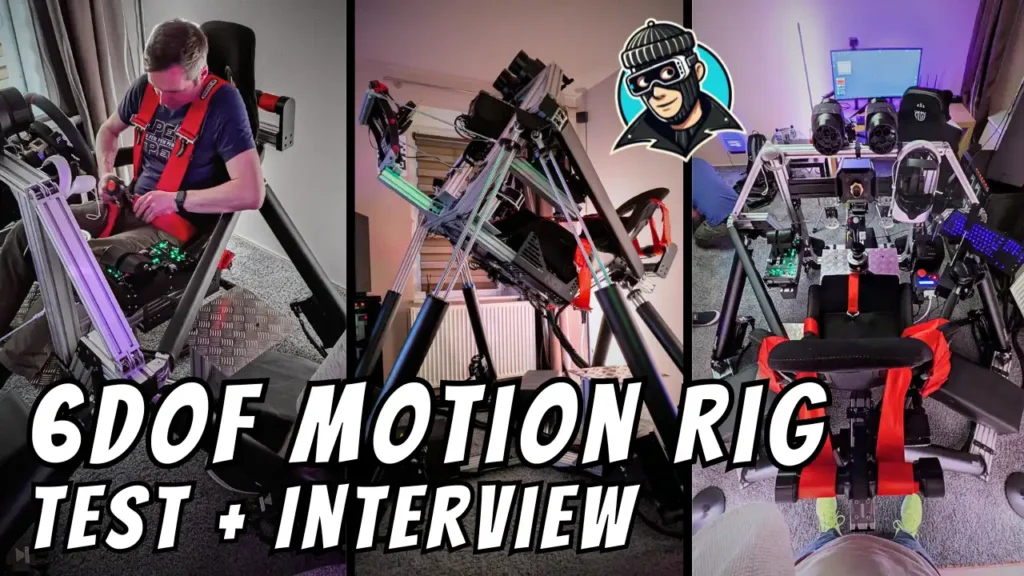
Some time ago, I had the opportunity to try an especially elaborate motion rig together with Jan at Basti’s place. Anyone involved in sim racing or flight simulation has probably seen systems like this in videos before: moving cockpits designed to physically transfer driving and flight movements to the body. But experiencing such a system in person is something entirely different.
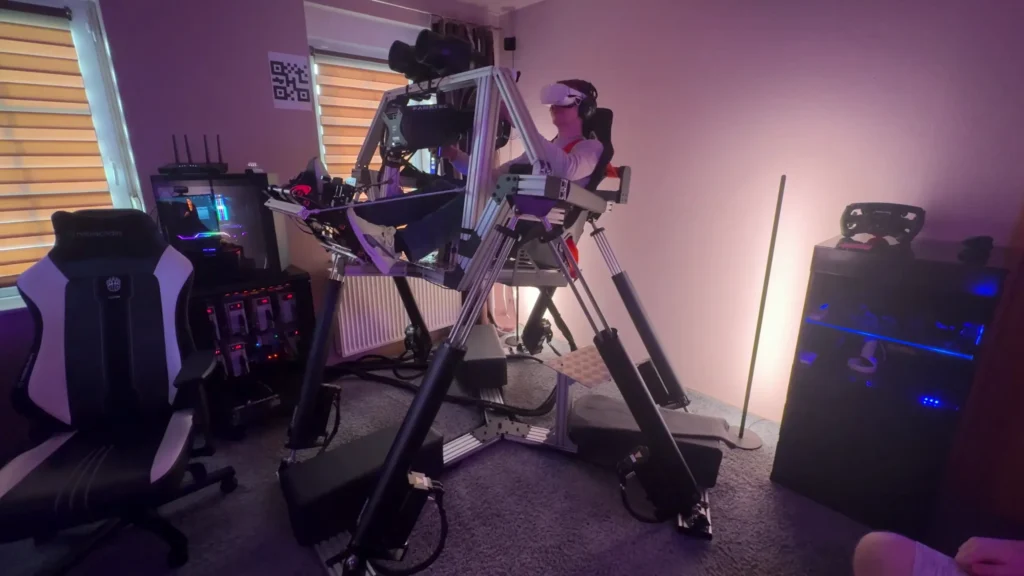
Basti has been deeply involved with so-called 6DoF motion rigs for years. “6DoF” stands for “Six Degrees of Freedom,” meaning movement in every direction: forward, backward, left, right, up, down, as well as rotations and tilts. The goal is to make movements from simulators feel as physically believable as possible.
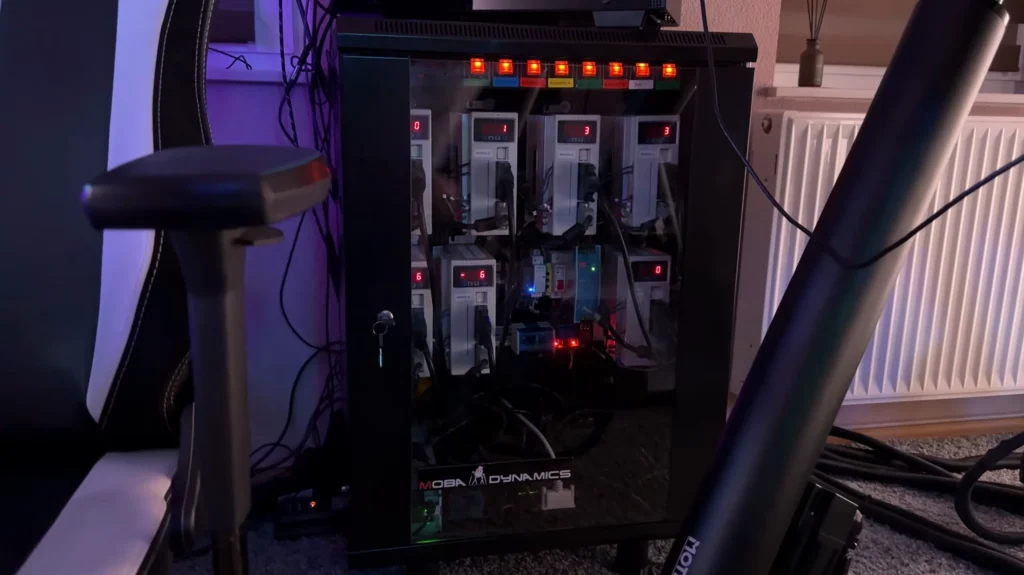
Even at first glance, it becomes obvious how much technology comes together in a setup like this. Servo motors, actuators, control cabinets, electronics, harness systems, wind simulation, force-feedback steering wheels, and modular extensions. At the same time, everything feels surprisingly precise and controlled. That was one of the main topics I discussed in detail with Basti.
How VR Led to a Motion Rig
What I found especially interesting was how Basti got into this topic in the first place. The starting point was not sim racing directly, but VR. He explained that the immersion of modern VR headsets eventually brought him to a point where something essential still felt missing: physical feedback. The image inside the headset had already become convincing enough that only the forces themselves were absent to complete the illusion.
At first, the setup involved relatively simple solutions like bass shakers. Small vibration systems designed to make engines, curbs, or road surfaces physically noticeable. Today, these systems are widespread in sim racing, but at the time they were still fairly niche. That starting point illustrates quite well what these setups are really about. Not creating something spectacular for the sake of appearance, but giving the brain additional sensory information. Even relatively simple vibrations can make a vehicle feel more believable. A full motion rig takes this concept much further.
What a 6DoF Motion Rig Actually Does
The rig itself is based on several highly precise servo motors that generate movement through actuators and spindles. This allows the entire construction to move extremely quickly and accurately.
What impressed me most was the directness of the movements. The system reacts with virtually no noticeable delay. Basti explained that the actuators can currently target around 5,000 positions within only a few centimeters of movement range. This level of precision allows small road imperfections, braking maneuvers, or weight shifts to feel believable.
The goal is not to perfectly recreate real G-forces. That would hardly be physically possible in a normal room. Instead, the system works with carefully designed movement illusions. Small movements, harness tensioners, vibrations, and wind simulation complement each other in a way that allows the brain to construct a far more intense overall sensation.
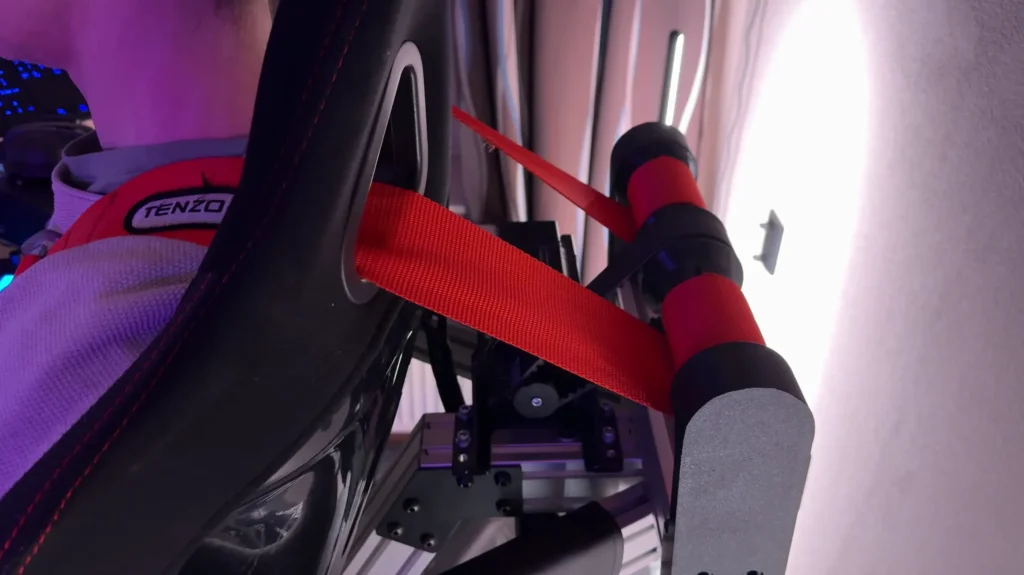
I found the harness tensioners particularly fascinating. During braking, the belts automatically tighten and simulate the feeling of being pushed into the harness. Wind simulation can apparently contribute enormously to immersion as well. Basti described a situation involving an open-wheel formula car where the wind suddenly created a brief moment of feeling as if he was no longer sitting inside a room at all.
These are exactly the moments I find especially fascinating throughout the XR space in general. Not necessarily pure image quality or resolution, but situations where multiple sensory impressions suddenly begin working together.
The Technology, Maintenance, and Reality Behind Systems Like This
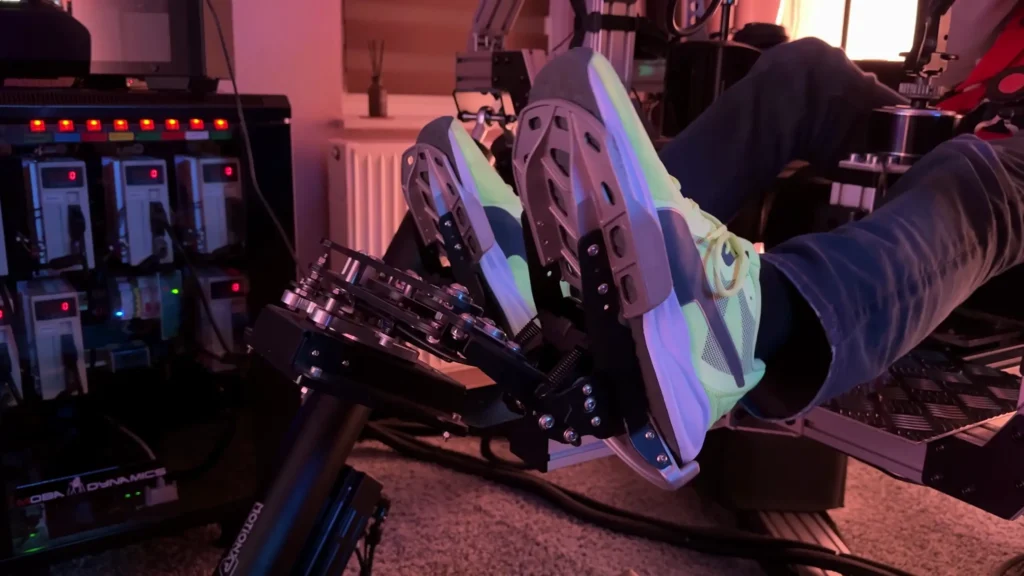
From the outside, setups like these almost resemble industrial machinery. And to some extent, they really are.
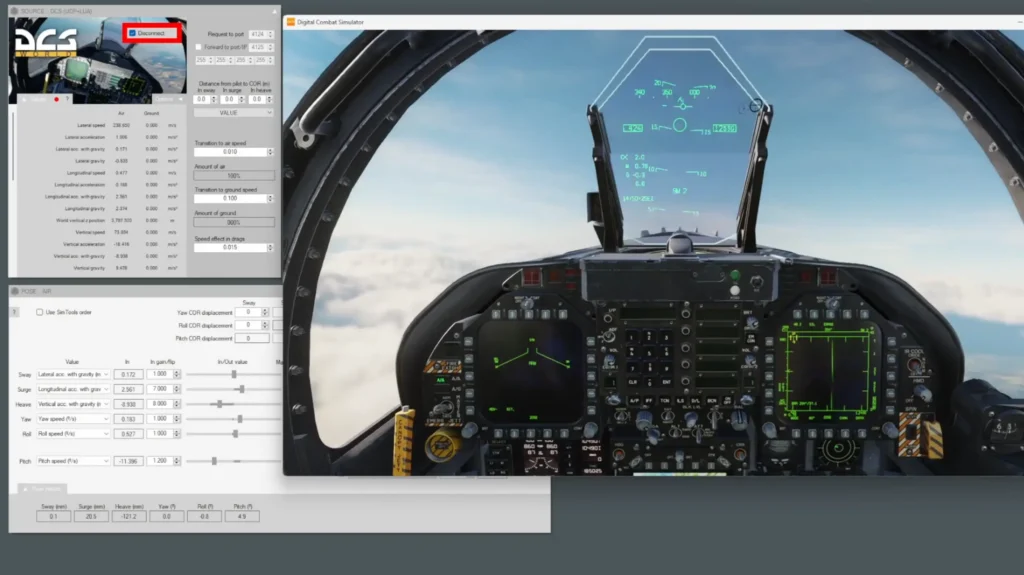
In the background, a full control cabinet handles electronics, safety circuits, and motor controllers. The software continuously calculates which movements the actuators need to perform based on telemetry data from the respective simulation. What was particularly interesting is how much data modern simulators can already provide. Speed, braking forces, road surface details, acceleration, or flight movements can all be read directly from the game and translated into physical feedback.
Despite the technical complexity, Basti surprisingly often mentioned that such systems can remain relatively low-maintenance over the long term. High-quality components, proper lubrication, and a clean mechanical setup help reduce wear significantly. The more demanding part is often the assembly and configuration process itself. Especially when complete systems involving a PC, steering wheel, flight stick, software, and motion configuration need to be set up, an enormous amount of work goes into it. That is why Basti now not only assists with setup but also offers complete turnkey solutions including instruction and calibration.
You can clearly notice how much passion is behind the topic. The conversation never felt like a traditional product discussion, but much more like someone talking about a hobby they have continued diving deeper into over many years.
More Than Just a Gaming Gadget
Motion rigs like these are obviously not aimed at the mass market. They require space, money, technical interest, and often quite a bit of time. Still, they demonstrate very impressively where immersive technologies could be heading.
VR alone can already feel highly convincing. But once movement, haptics, vibrations, wind, or physical feedback are added, the experience often changes dramatically. That is why systems like these fascinate me so much. In the end, it is not only about seeing something. It is about the body beginning to at least partially accept virtual situations as believable.
It is exactly at this intersection between technology and perception where XR experiences often become truly interesting.