
Lighthouse or SLAM? Both tracking systems have their advantages and disadvantages. But how noticeable are the differences when actually playing VR games? I’ve been wanting to explore this question for quite some time. With the Pimax Dream Air and Dream Air SE, I finally had the opportunity to compare both tracking systems directly.
For my real-world comparison, I chose two games that place different demands on tracking: Beat Saber, with its fast controller movements, and Crossfire: Sierra Squad, where smooth and precise aiming is essential. Some of the results actually surprised me.
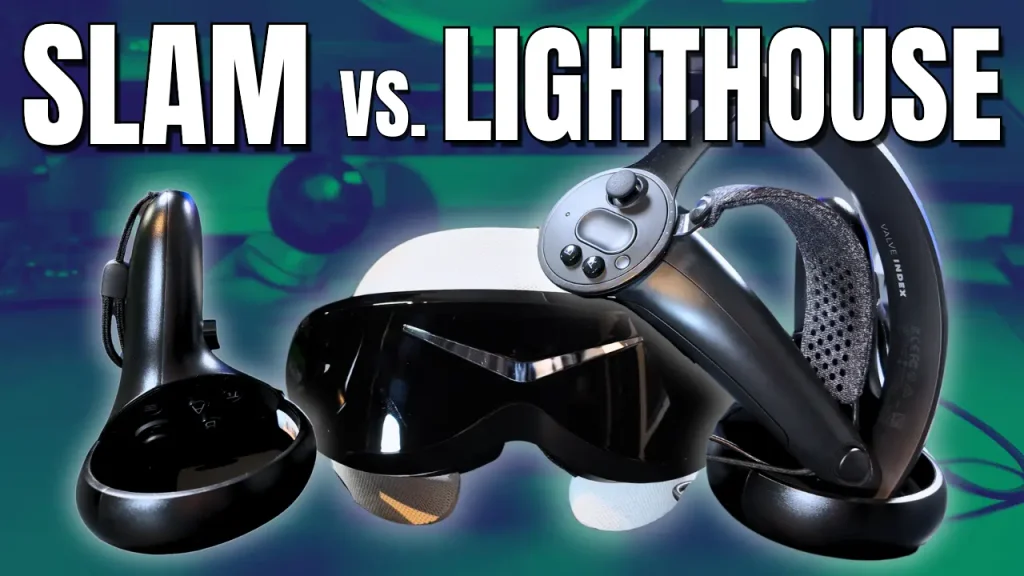
Lighthouse and SLAM: Two Different Tracking Systems
Lighthouse tracking relies on external base stations that need to be positioned or mounted in your room. If you already own a compatible SteamVR setup, you can continue using your existing base stations and controllers. However, if you’re starting from scratch, the additional costs can be quite substantial. In return, Lighthouse generally offers very precise and reliable tracking.
However, the system requires a clear line of sight between the base stations and the sensors on the headset and controllers. If these connections are blocked, for example by other people in the room, tracking can become unstable or even fail completely. These interruptions can be particularly frustrating during gameplay.
SLAM, or inside-out tracking, works without external base stations. Cameras on the headset capture the surrounding environment and use that information to determine the headset’s position and orientation. Of course, compatible controllers still cost money, but the overall entry price is considerably lower than that of a complete Lighthouse setup.
How reliably this works depends heavily on the tracking software and the environment. Based on my experience so far, Pimax still hasn’t reached the same level of reliability as the Meta Quest. The room should be well-lit, with even lighting throughout. Mirrors and highly reflective surfaces can cause problems. The cameras also need recognizable features in the environment to maintain their orientation. That’s why I’ve attached printed QR codes to some of the white walls in my VR room to provide additional contrast.
Dream Air or SE? SLAM or Lighthouse?
Visit my Pimax Dream Air Buying Guide to compare models and tracking options, find recommended accessories, and choose the right setup for you.
My Test Setup: Pimax Dream Air vs. Dream Air SE
For this comparison, I used the Pimax Dream Air SE with SLAM tracking and the Pimax Dream Air with Lighthouse tracking. Apart from the optical system, the two headsets are largely identical in their respective tracking configurations. That’s why I consider a direct comparison between them perfectly reasonable.
The original SLAM test footage was recorded using firmware 1.0.5 and Pimax Play 2.0.3. For Lighthouse, I used firmware 1.0.6 and Pimax Play 2.0.4. Afterwards, I tested both games again with SLAM using firmware 1.0.6 and Pimax Play 2.0.4. I couldn’t notice any meaningful difference in tracking performance.
My goal wasn’t to conduct a technical measurement of tracking accuracy. Instead, I wanted to find out how both systems behave during actual gameplay and which differences I could personally notice.
Beat Saber: SLAM Surprises Me with the Better Result
For Beat Saber, I played the same song on Hard difficulty dozens of times to collect reasonably meaningful comparison results. One result in particular surprised me: My best SLAM run actually achieved a slightly higher score than any of my Lighthouse runs.
My maximum combo was also slightly higher during my best SLAM run. Of course, this doesn’t automatically mean that SLAM provides more accurate tracking. My own performance naturally varies from one attempt to another. Nevertheless, the result shows just how well the Dream Air SE’s inside-out tracking performs in Beat Saber.

Subjectively, I still feel that I can rely on Lighthouse a little more. With SLAM, there are occasional moments when I think I really should have hit a particular block. However, I can’t say for certain whether tracking was actually responsible every single time. In any case, these perceived tracking issues had less of an impact on my best results than I would have expected.
A player who has mastered a particular song almost perfectly might be able to identify more subtle differences between the two systems. For me, however, SLAM and Lighthouse were practically equal in terms of the results I could achieve in Beat Saber.
In the video, I’ve synchronized my two best runs and placed them side by side. This makes it possible to compare the movements and results directly.
Crossfire: Sierra Squad – Lighthouse Excels at Precise Aiming
Things looked a little different at the shooting range in Crossfire: Sierra Squad. Here, the difference between the two tracking systems was much more noticeable to me.
With Lighthouse, the weapon follows my movements very smoothly and precisely. With SLAM tracking, on the other hand, there’s some visible instability in the weapon’s movement, which becomes particularly noticeable when aiming. That doesn’t mean you can’t achieve good results with SLAM. I was still able to hit my targets and complete the test without any major problems.
For me, the main difference is how smooth and reliable the weapon movements feel. Especially when carefully aiming at individual targets, Lighthouse gives me a greater sense of control. In this scenario, I clearly prefer the external tracking system.
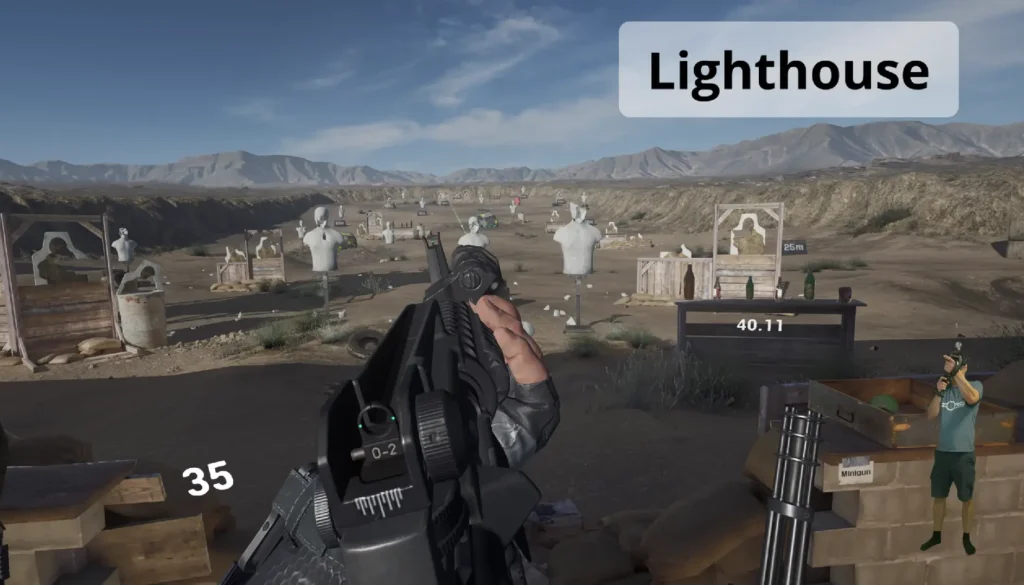
I deliberately chose the shooting range for this comparison because it provides a relatively simple and controlled testing environment. Of course, this test doesn’t recreate a hectic multiplayer situation involving rapid turns, changing body positions, and numerous simultaneous movements.
The complete Sierra Squad recordings are also included in the video: one minute with Lighthouse and one minute with SLAM, allowing you to observe the differences in weapon movement directly.
Dream Air or SE? SLAM or Lighthouse?
Visit my Pimax Dream Air Buying Guide to compare models and tracking options, find recommended accessories, and choose the right setup for you.
My Conclusion: Is Lighthouse Really Better?
My comparison shows that the answer largely depends on what a particular game demands from the tracking system.
In Beat Saber, I was able to achieve results with SLAM that were at least as good as those with Lighthouse. My best SLAM run was actually slightly better. That surprised me, especially since I still have more confidence in Lighthouse tracking on a subjective level.
When it came to precise aiming in Crossfire: Sierra Squad, however, the difference was more noticeable. The smoother weapon movements and the more reliable feeling when aiming clearly make Lighthouse my preferred choice.
If you already own a Lighthouse setup, the corresponding Dream Air version offers a tracking solution that I personally prefer. However, if you’re just getting started with PCVR, you’ll need to consider the significant additional costs. My Beat Saber test in particular shows that SLAM can be a convincing alternative.
Whether Lighthouse is worth the extra money ultimately depends on your personal expectations and the types of games you prefer to play.
You can see the differences for yourself in the accompanying video. After my analysis, you’ll find the complete test recordings from Beat Saber and Crossfire: Sierra Squad.
What’s your experience with SLAM and Lighthouse? I’d be particularly interested to hear whether you’ve achieved similar results in fast-paced games or noticed the same differences when it comes to precise aiming.