
“PCVR is dead.” “Standalone has already won.” “Mobile chips can’t deliver real VR.”
Anyone who has been involved with virtual reality for a while has probably heard statements like these countless times. Some of us have probably said them ourselves. What is often overlooked is that these debates are usually less about technology and more about how people justify their own decisions. Virtual reality is rarely a casual hobby. Choosing a headset often means investing money, time, and a certain amount of hope that you made the right choice. The more someone invests, the stronger the desire can become to defend that decision.
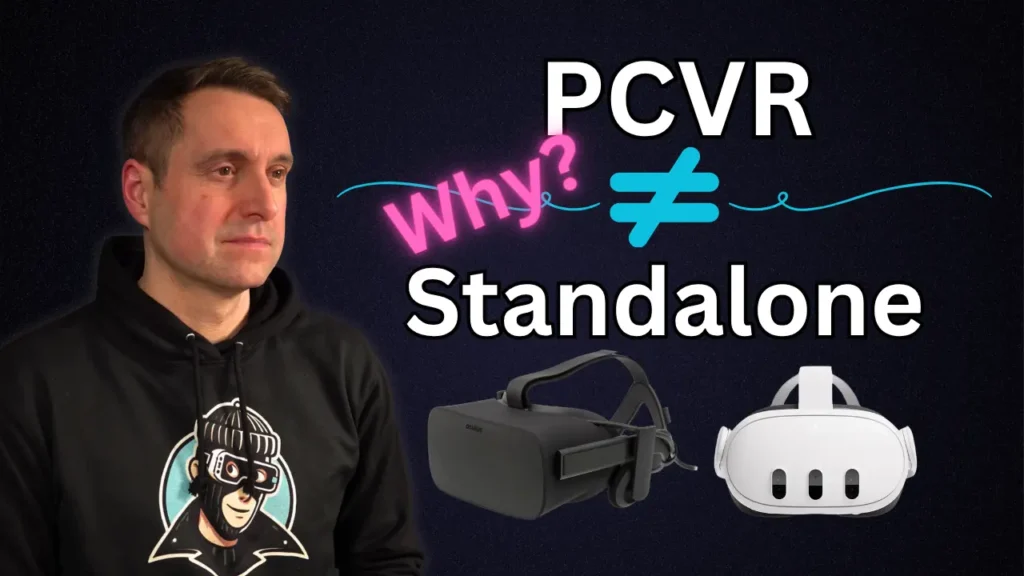
That is why PCVR and standalone VR are often treated as if they were locked in a direct competition. In reality, however, there are good reasons to see something different happening. From my perspective, the VR industry is not going through a process of one side replacing the other. What we are witnessing is a consolidation of the market. Consolidation does not mean the market is shrinking. It means the market is no longer trying to be everything at once. PCVR, standalone VR, and mixed reality are increasingly becoming distinct segments with different goals and different strengths. Yet these areas are still frequently discussed as though only one of them can ultimately survive.
To understand why the market looks the way it does today, it helps to take a step back. For many people, the modern VR era began with the Oculus Rift Development Kit in 2012. Funded through crowdfunding, the headset gave developers an early glimpse of what virtual reality could become. When the consumer version of the Oculus Rift launched in 2016, it cost around €741 and offered a resolution of 1080 × 1200 pixels per eye. By today’s standards that sounds modest, but at the time it represented the limits of what was realistically achievable. If you wanted VR, you needed a powerful PC. VR essentially meant PCVR.
Shortly afterward, the HTC Vive arrived with its Lighthouse tracking system. The two headsets were technically similar, yet the first camps and loyalties quickly began to form. Debates about which system represented the better version of VR have been part of the community from the very beginning. At the same time, early attempts were already being made to free VR from the PC. Products such as Samsung Gear VR and Google Daydream pursued the idea of making virtual reality more accessible and convenient. The hardware simply was not powerful enough yet to make them a true alternative. It was only with the Oculus Go and later the first Quest that it became clear standalone VR could be more than a simplified version of PCVR. As the Quest lineup evolved, standalone VR established itself as its own market segment rather than a temporary stepping stone.
From the beginning, PCVR and standalone VR pursued different goals. PCVR was designed to push hardware as far as possible. Higher resolutions, wider fields of view, more complex simulations, and technically ambitious experiences were always at the center of its development. That path has led to headsets with displays so sharp that individual pixels are now difficult to see. At the same time, this approach comes with trade-offs. Powerful hardware is expensive, and cables, dedicated play spaces, or external tracking systems are often still part of the equation.
Standalone VR evolved with a different focus. Convenience, portability, and accessibility took priority. More capable mobile processors and technologies such as pancake lenses made it possible to build smaller and more practical devices. The goal was never maximum performance but rather the easiest possible access to virtual reality. Interestingly, these two worlds were never completely separate. Pancake lenses became popular in standalone headsets before finding their way into modern PCVR devices. Conversely, concepts such as inside-out tracking were explored in PCVR before becoming standard in standalone systems. Over the years, both segments have learned from one another and benefited from each other’s innovations.
The same dynamic can be seen in software development. For many developers today, choosing between standalone and PCVR is primarily a practical decision. Standalone offers a large user base and a predictable hardware platform. PCVR offers more performance and more room for technical experimentation. As a result, many projects are developed for standalone devices first and later brought to PC. While these ports often work well technically, they do not always take full advantage of modern PC hardware. This is where much of the frustration within the PCVR community originates. People who invest in powerful hardware naturally want software that makes use of that potential. When new releases feel more like high-resolution versions of standalone games, it is easy to see why some users feel that PCVR has stopped moving forward.
From my perspective, statements such as “PCVR is dead” or “Standalone is just mediocre” are mostly expressions of different expectations. They are neither proof that PCVR has failed nor proof that standalone VR has won. The two approaches simply serve different needs and different audiences. Those looking for maximum visual fidelity, deep simulations, and technical freedom will likely continue to find their home in PCVR. Those who want a simple and convenient way to enter virtual worlds will find compelling options in the standalone space. The market does not need only one of these directions. There is room for both.
Perhaps that is the most important development of the past few years. VR is not becoming smaller. It is becoming more specialized. The boundaries between different segments are becoming clearer, and their strengths are becoming easier to understand. What often looks like a battle between competing platforms may actually be a sign that the market is maturing.