
Short version: I can’t recommend the 57PPD module of the Crystal Super right now.
And that’s less because it’s fundamentally bad, but more because of what it’s competing with. Within the Pimax Crystal Super ecosystem, the 50PPD module sets a very high bar. And that’s exactly what this module has to measure up against.
Video
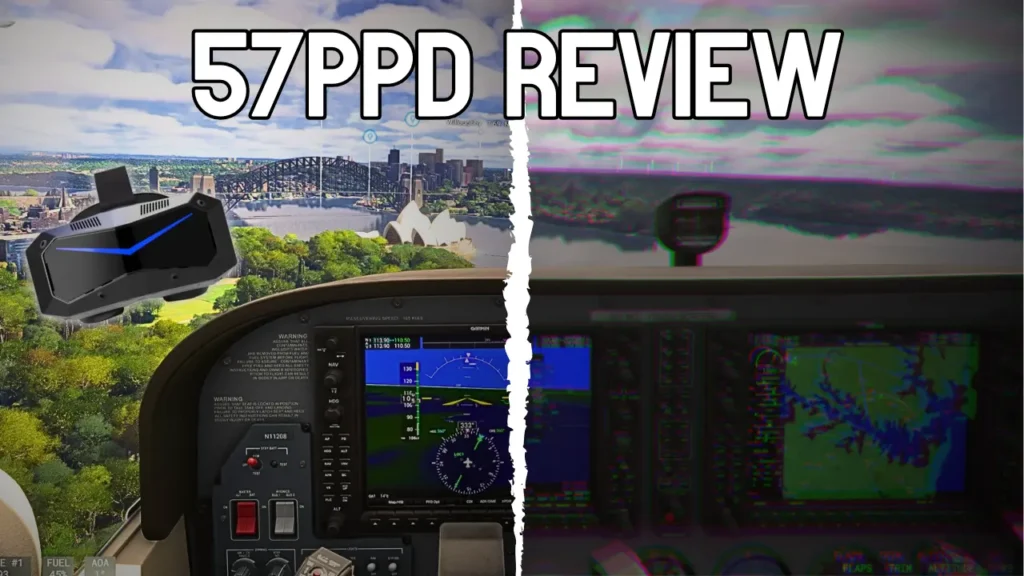
Watch the full video here:
Initial context
As always, full transparency: I received the 57PPD module from Pimax for this review. That doesn’t influence my opinion.
If something feels off, I don’t jump to conclusions right away. I usually check back with Pimax first. Sometimes things get resolved, sometimes they don’t. But I think it’s important not to present half-baked conclusions.
Swapping modules – smoother than expected
The 57PPD module was the first time I really tested swapping optical modules on the Crystal Super.
I actually had Half-Life: Alyx running, removed the 50PPD module, and inserted the 57PPD module. The game immediately closed, the new module was recognized, and I was able to restart right away.
It’s not a full “hot swap,” but it feels well implemented. And it makes sense that the game needs to close, since things like render resolution and internal profiles change with the module.
Looking for the Pimax Crystal Super?
Visit my Pimax Buying Guide for an overview of all current Pimax headsets, optical engines, recommended accessories, and the latest product links.
Physical differences – subtle, but noticeable
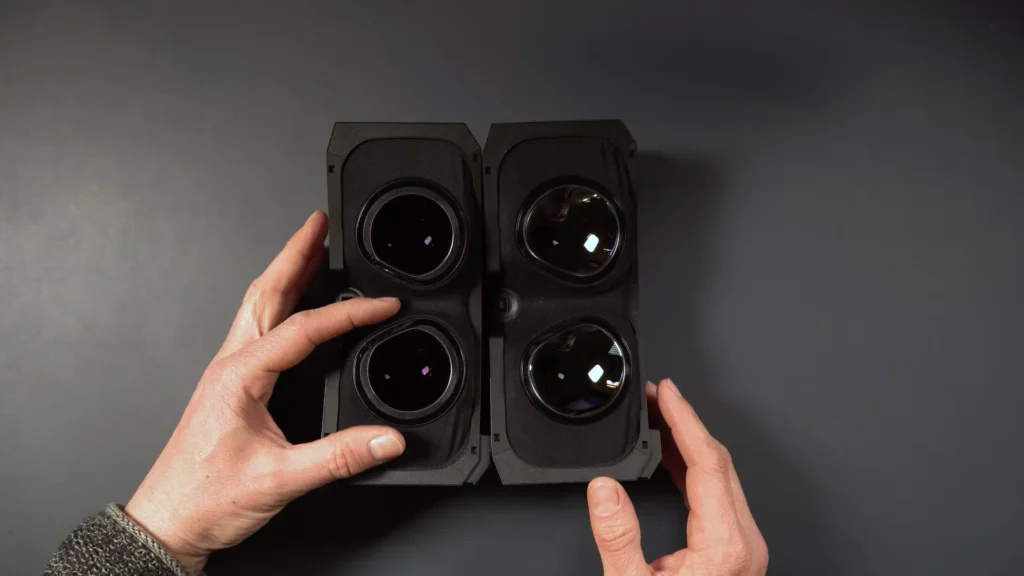
At first glance, both modules look almost identical. There’s a small sticker on the 57PPD module, but that’s about it.
Looking closer, you notice:
- significantly smaller lenses
- about 20 grams less weight
Technically, most things remain the same, including the QLED panels. So the differences mainly come from the optics.
Field of view – the first real compromise
The moment you put it on, the smaller field of view becomes obvious.
My measurements:
- around 100–102° horizontal
- around 86–87° vertical
One thing I noticed: the vertical FOV isn’t symmetrical. It’s more limited upwards than downwards. This also exists on the 50PPD module, but it feels more noticeable here.
Binocular overlap is slightly higher on paper, but I can’t perceive any real difference.
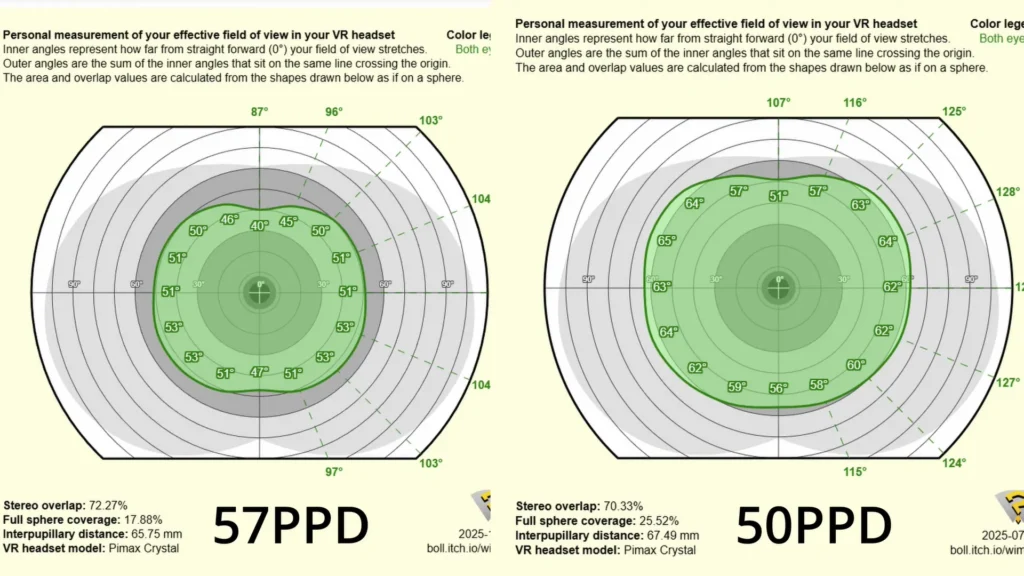
Image quality – mostly familiar
A lot of things behave exactly as expected:
Local dimming is strong.
Glare isn’t an issue.
Mura is present, but comparable to the 50PPD module.
What changed is my perception. I’ve become more sensitive to mura over time. Not because it got worse, but because I’ve spent more time analyzing these displays.
That applies to both modules.
Sharpness – hard to pin down in practice
The main selling point of the 57PPD module is higher pixel density.
Because of the smaller FOV, pixels are packed more tightly, which should result in a sharper image.
In practice, I find this very hard to clearly notice. If you actively look for it, you might see a difference. But in actual gameplay, it’s not something that consistently stands out.
This is one of those cases where the theoretical advantage doesn’t fully translate into a meaningful real-world benefit.
The real issue: sweet spot and chromatic aberration
This is where things start to fall apart for me.
The sweet spot is small.
And you notice it immediately.
Yes, the center can look very sharp. But that sharp area is so limited that you constantly move outside of it.
And as soon as you do, chromatic aberration becomes clearly visible.
You don’t have to look far. Even small eye movements are enough.
On the 50PPD module, this also exists—but much further out towards the edges. Here, it happens much sooner.
I tested this across multiple games, and it kept pulling me out of the experience.
Adaptation – something I didn’t expect
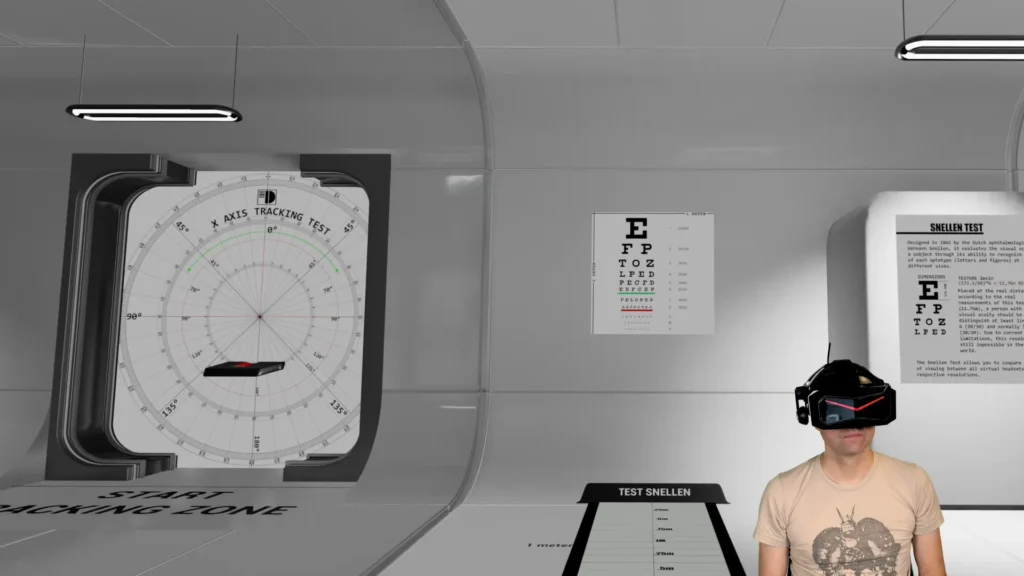
What surprised me: over time, I actually got somewhat used to it.
The chromatic aberrations don’t disappear, but they become less distracting. Your brain starts to filter them out to some extent.
That’s not unusual in VR, but still worth mentioning.
That said, it doesn’t make the issue go away. Especially when switching back to the 50PPD module, the difference is still very obvious.
Can software fix this?
The obvious question is whether Pimax can improve this with software updates.
Maybe to some degree. But I’m skeptical that it can be fully resolved.
If the root cause lies in the lens design, software can only do so much.
This also isn’t an isolated observation—other reviewers have reported similar issues.
Performance – where the module actually makes sense
With some distance, my view on this module has become a bit more nuanced.
There are definitely users for whom the 57PPD module can make sense.
The reason is simple: smaller FOV means less to render. That reduces GPU load.
In racing sims, for example, this can be a real advantage. Your focus is mostly straight ahead. Peripheral vision is less critical, while stable frame rates and performance headroom are much more important.
In that context, the trade-off becomes more understandable:
You lose FOV and visual consistency, but gain performance.
But there’s a catch
You can achieve a similar effect with the 50PPD module.
Using Pimax Play or the OpenXR Toolkit, you can reduce the field of view manually, which also lowers GPU load.
So the main advantage of the 57PPD module isn’t entirely exclusive to it.
Dynamic foveated rendering – not a great match
Dynamic foveated rendering is supposed to benefit setups like this.
But here it doesn’t fully work in its favor.
As soon as your gaze leaves the small sweet spot, chromatic aberration becomes visible again. That doesn’t feel like a great fit for how DFR is supposed to work.
Who might still like it?
If you’re coming from something like the HP Reverb G2, you’re already used to a smaller sweet spot.
In that case, the 57PPD module can still feel like an upgrade.
Within the Crystal Super lineup, though, I see it differently.
Final thoughts
The 57PPD module isn’t a bad product. It works, and it does deliver a sharp image in the center.
But in everyday use, other factors matter more:
How stable is the image across the field of view?
How large is the usable area?
How often do visual artifacts break immersion?
And this is where it struggles.
Compared directly, the 50PPD module offers a more balanced experience: a larger sweet spot, better edge-to-edge clarity, and fewer noticeable artifacts.
So my conclusion remains:
I can’t recommend the 57PPD module right now—
with the exception that it can make sense for very specific use cases, especially those focused on performance.
Interested in the Pimax Crystal Super?
You´ll find all current Pimax headsets, optical engines, recommended accessories , and the latest product links in my Pimax Buying Guide.