
With the Meta VR Glasses, Meta unveiled an unusually compact VR headset at this year’s Meta Connect. Weighing around 100 grams, featuring high-resolution Micro-OLED displays and an external processing unit, the device aims to combine movies, gaming, and mobile productivity in a single package. However, Meta has made significant compromises when it comes to the field of view. Can this concept actually work, and who are these glasses really for?
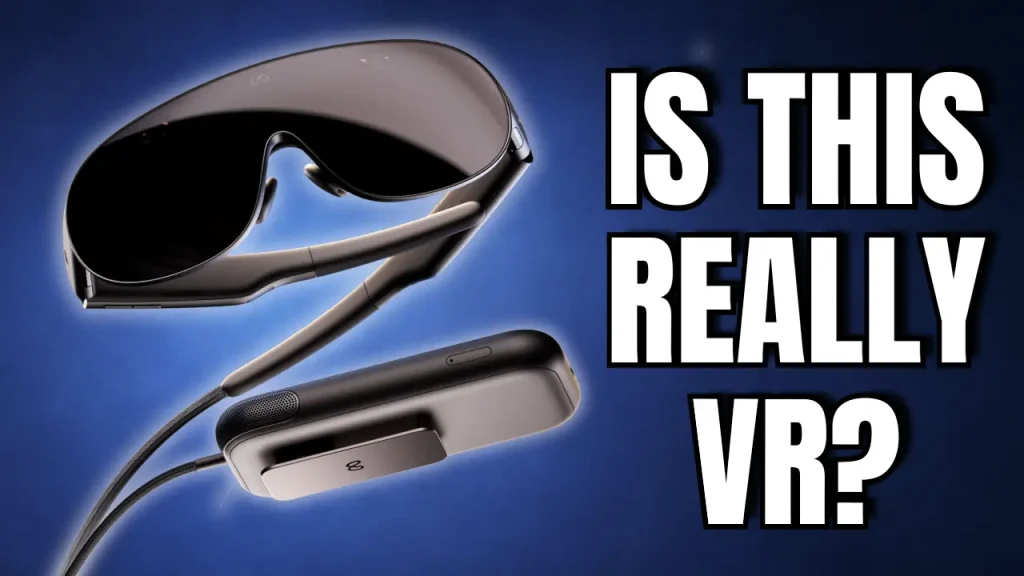
Among all the smart glasses showcased at Meta Connect, I almost missed the new Meta VR Glasses. They blended in so well with the other devices that their reveal genuinely caught me by surprise. At first glance, they look more like a slightly oversized pair of sunglasses than a traditional VR headset.
I also find the name interesting. Although the device looks nothing like a Meta Quest 3, Meta has deliberately chosen to include VR in its name. But that also creates certain expectations when it comes to gaming and immersion. Whether these tiny glasses can actually live up to those expectations is one of the most interesting questions for me.
Project Phoenix: A New Approach to VR
Before its official unveiling, the glasses were known as Project Phoenix. Contrary to what some might have expected, they are not a successor to the Meta Quest 3. Instead, Meta is taking a different approach with the VR Glasses: creating an extremely lightweight, standalone device that combines personal cinema, gaming, and mobile productivity.
To reduce the weight to approximately 100 grams, Meta has moved much of the hardware out of the glasses themselves. The frame primarily houses the displays, lenses, cameras, and sensors. The processing unit, storage, and battery are located in a separate puck that can be attached to your pocket, for example. Both components are connected by a cable.
We’re already familiar with the concept of an external battery from the Apple Vision Pro. However, Meta takes things one step further by moving the entire processing unit into the puck as well. This significantly reduces the weight resting on your face. At the same time, the connecting cable remains an essential part of the system. It’s also worth noting that the advertised 100 grams refer exclusively to the glasses themselves, not the entire hardware setup.
Micro-OLED, Eye-Tracking and Snapdragon Reality Elite
In terms of hardware, the Meta VR Glasses have quite a lot to offer. Two Micro-OLED displays deliver a resolution of 2,412 × 2,288 pixels per eye, providing a higher resolution than the Meta Quest 3. The refresh rate goes up to 120 Hz, and Meta specifies a pixel density of 37 pixels per degree (PPD). The glasses also feature compact pancake lenses.
Several cameras are integrated for spatial tracking and hand tracking. Color cameras enable passthrough, allowing users to see their real-world surroundings while wearing the glasses. There’s also a dedicated depth sensor.
Particularly interesting is the eye-tracking system, which uses a total of four cameras, two for each eye. This allows the glasses to detect where the user is looking, enabling features such as gaze-based navigation combined with hand gestures.
Eye tracking also enables foveated rendering. This technique maximizes image quality in the area the user is currently looking at, while reducing rendering resolution outside that area to save processing power. Especially in a compact standalone device, this technology could make a significant contribution to overall image quality.
Technical Specifications at a Glance
- Micro-OLED
- 2.412 × 2.288 Pixel per eye
- Refresh Rate: Up to 120 Hz
- Pixeldensity: 37 PPD
- Lenses: Pancake
- Field of view (FOV): 70° horizontal / 66° vertikal
- Eye-Tracking
- SOC: Snapdragon Reality Elite
- 12 GB RAM
- 128 GB RAM + microSD up to 1TB
- Weight: 100g without Puck
- Battery Life: Up to 3 Hours
- Launch Price: $1,299
The external puck is powered by the Snapdragon Reality Elite, paired with 12 GB of RAM, 128 GB of internal storage, and a microSD card slot. The battery is also housed inside the puck and is expected to provide up to three hours of battery life when playing high-resolution media. The device can be charged via USB-C while in use.
This makes the Meta VR Glasses much more than a simple pair of display glasses that merely mirrors a smartphone screen. Thanks to the dedicated processing unit, they can run apps and games independently.
Personal Cinema, Gaming, and Mobile Productivity
Meta is focusing on three main areas: entertainment, gaming, and productivity. I think it’s precisely this combination that defines the concept behind the device. Instead of planning an entire evening around VR, you could simply put on the glasses whenever you want to watch a movie, play a game, or work on a larger virtual screen.
A Personal Cinema on the Go
When it comes to entertainment, Meta is primarily focusing on the experience of having your own personal cinema. The displays support Dolby Vision for compatible content, while Dolby Atmos is designed to deliver spatial audio through the speakers integrated into the glasses’ frame. According to Meta, the VR Glasses are also the first VR device to receive IMAX Enhanced certification.
Meta has announced 3D movies, virtual cinema environments, and special formats that integrate the surroundings of the virtual screen into the movie itself. This could be particularly interesting for films that go beyond the traditional rectangular screen and turn parts of the surrounding environment into an immersive experience.
Sports broadcasts are also expected to play a role. Meta promises immersive experiences designed to make viewers feel closer to the action than they would when watching on a conventional television. How convincing these formats will actually be, and which content will be available in Germany, remains to be seen.
Quest-Games and Xbox Cloud Gaming
Despite their compact form factor, the Meta VR Glasses are expected to provide access to the Quest game library. At launch, more than 75 games are expected to be fully playable using hand gestures alone. Those who prefer traditional VR controllers can use the Meta Quest 3’s Touch Plus controllers.
For existing Quest owners, the ability to access their current game library on the VR Glasses could be particularly appealing. However, not every game is likely to be equally suited to the significantly smaller field of view.
Additionally, a Bluetooth gamepad will allow users to play games through Xbox Cloud Gaming on a large virtual screen. The lightweight form factor could be particularly appealing for this type of gaming, where full immersion in a virtual world isn’t the main priority.
Virtual Monitors Instead of a Laptop Screen
Another major focus is productivity. The glasses are designed to provide a large virtual monitor or multiple virtual workspaces. A Mac or Windows PC can be connected either wirelessly or via USB-C. Conventional keyboards and mice are also supported.
Meta also demonstrated a virtual keyboard and touchpad projected onto an ordinary tabletop. This allows users to type directly on their desks while viewing their virtual workspaces in front of them. Thanks to color passthrough, the physical keyboard, desk, and surrounding environment remain visible.
If this works reliably, I could definitely see myself using these glasses as a mobile workstation. Having multiple virtual monitors available while traveling, without having to carry additional hardware, is certainly appealing. However, whether the VR Glasses are comfortable enough to wear for extended periods is something only a hands-on test will reveal.
Just 70 Degrees of Field of View: The Biggest Compromise?
One specification in particular catches my attention as a VR gamer: Meta lists a horizontal field of view of just 70 degrees and a vertical field of view of 66 degrees. That’s considerably less than what I’m used to from my regular VR headsets.
However, the glasses feature an open design. Unlike a fully enclosed VR headset, they allow you to see your real-world surroundings not only through the passthrough cameras but also by looking past the sides of the glasses.
When using a virtual monitor or watching a movie on a large virtual screen, this could actually feel quite natural. I’ve had similar experiences with the Meta Quest 3. For example, when I’m working on a virtual screen, a limited field of view isn’t necessarily something that bothers me.
Immersive VR gaming, however, is a different story. If I want to feel completely immersed in a virtual world, I’ll still be able to see my real-world surroundings outside that 70-degree field of view. While the open design increases my awareness of the physical environment, it doesn’t expand the displayed VR image. Meta offers optional light blockers to hide your surroundings, but these obviously won’t increase the field of view.
For me, this is the key difference between the Meta VR Glasses and a traditional VR headset. The glasses could be excellent for virtual screens, but they require a significant compromise when it comes to immersive gaming.
Do the Meta VR Glasses Support PCVR?
As a PCVR enthusiast, I’m particularly interested in whether the glasses can also be used with a gaming PC. In principle, devices with a compatible DisplayPort video output can be connected via the puck’s USB-C port. This could theoretically include Macs and Windows PCs.
However, being able to transmit a video signal doesn’t automatically mean that full PCVR is supported. For SteamVR, for example, the headset’s positional tracking data and controller inputs would also need to be transmitted to the computer. Whether the Meta VR Glasses will support this kind of connection, and how it might work, remains unclear.
Even if full PCVR support becomes available, I have to ask myself whether I’d actually want to use glasses with a horizontal field of view of just 70 degrees. Anyone who regularly plays with a Pimax Dream Air, Crystal Super, or another immersive VR headset probably has different priorities.
That’s why I suspect traditional PCVR enthusiasts aren’t the primary target audience for the Meta VR Glasses. For virtual workspaces, however, that same connection could be extremely interesting.
$1,299: Who Is This Concept Really For?
The announced starting price of $1,299 is one of the biggest challenges for me. At the time of the announcement, Meta had not yet revealed a German retail price. Compared to the Apple Vision Pro, the Meta VR Glasses initially seem relatively affordable. However, with this new device, Meta apparently aims to reach a broader audience that isn’t necessarily looking for a sophisticated VR setup.
Anyone who already owns a good television, a gaming console, and a powerful laptop will probably wonder what additional value these glasses actually offer. Perhaps it’s having a personal cinema that you can take anywhere. Maybe it’s having private virtual monitors while traveling. Or perhaps it’s the ability to combine movies, gaming, and productivity in a single device that weighs just around 100 grams on your face.
For this concept to succeed, however, the experience needs to be simple and comfortable enough to make people want to put the glasses on regularly. Wearing comfort, in particular, will play a crucial role. People who are already willing to spend a lot of money on VR hardware often place particular importance on immersion, image quality, and field of view. Yet field of view is precisely where Meta is making a significant compromise, probably due in part to the compact form factor.
This creates an interesting situation: the range of applications could appeal to a broad audience, but the high price means the glasses will need to deliver genuinely convincing added value.
Conclusion: A Versatile VR Headset with Clear Limitations
Following the presentation at Meta Connect, I see the Meta VR Glasses primarily as an interesting device for entertainment, casual gaming, and mobile productivity. The combination of low weight, high-resolution Micro-OLED displays, and an open design could prove particularly beneficial for these applications.
As a PCVR gamer, however, the limited field of view remains a major drawback for me. Even if Meta introduces full PCVR support in the future, I would probably still prefer a traditional VR headset for immersive gaming. At the same time, I don’t want to look at this concept exclusively from the perspective of a VR enthusiast. Not everyone wants to spend hours completely immersed in a virtual world. For someone who primarily wants to watch movies, play the occasional game, or work with virtual monitors while traveling, the Meta VR Glasses could be an interesting option.
Ultimately, what matters most is how well the entire system performs in everyday use. How comfortable are the glasses really? How convincing are the image quality and virtual workspaces? And is the overall experience good enough to justify spending $1,299? These are questions that can only be answered after a proper hands-on test. The glasses are scheduled to launch in spring 2027. That’s when we’ll find out whether Meta can establish a new category of VR devices with this concept or whether the compromises will prove too significant for many potential buyers.
One thing is certain for me: I’ll be particularly interested in taking a closer look at the VR Glasses’ comfort, image quality, and limited field of view.